
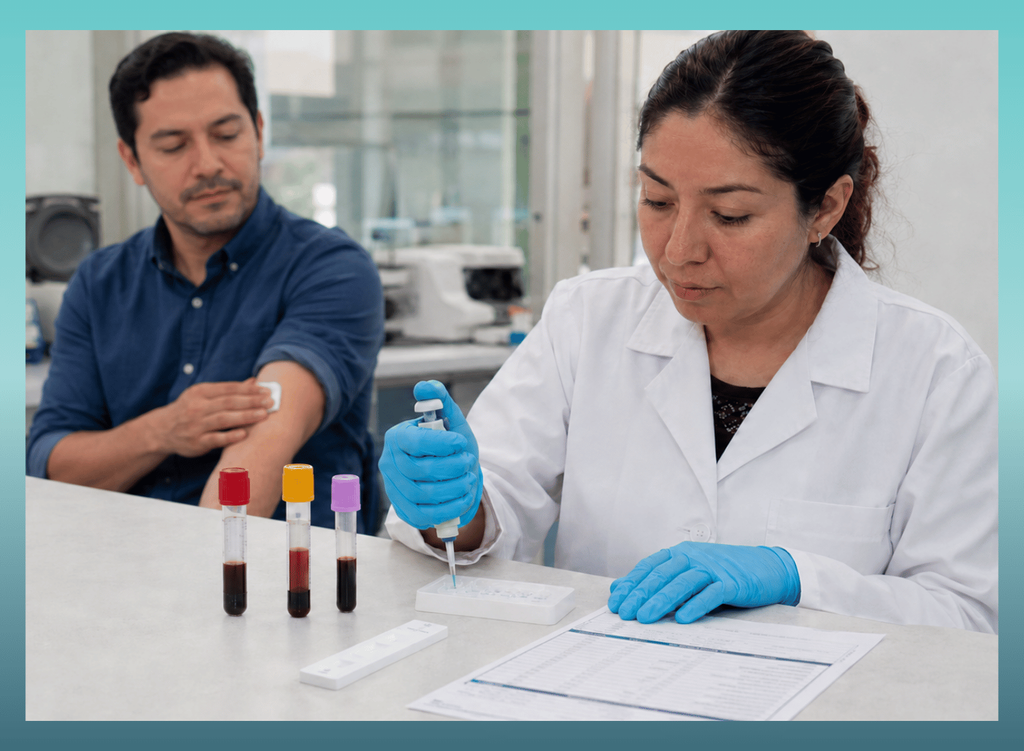
When searching for a C-reactive protein test at a laboratory, you may find names such as quantitative CRP, semi-quantitative CRP, high-sensitivity CRP, or hs-CRP. Although all these tests measure the same protein, they do not always provide the same type of result or serve the same purpose.
C-reactive protein levels may rise when inflammation is present in the body. A standard CRP test can help evaluate and monitor inflammatory processes, while a high-sensitivity CRP test measures lower concentrations more precisely and can provide additional information about cardiovascular risk.
Understanding these differences is important before booking a test or comparing results. This article explains what each type of CRP test measures, what it may be used for, and where these tests are available in Mexico.
What is C-Reactive Protein and Why Does It Increase?
C-reactive protein is produced primarily by the liver in response to inflammatory signals. It is one of the body’s acute-phase reactants, substances whose concentrations can change rapidly when the body responds to an infection, injury, surgery, or another inflammatory process.
An elevated CRP level suggests that inflammation may be present, but the test alone cannot determine where the inflammation is located or what is causing it. CRP may also increase due to inflammatory or autoimmune diseases, trauma, tissue damage, and other clinical conditions. Therefore, a high result does not automatically confirm an infection and must be considered alongside symptoms, medical history, and other test results.
CRP concentrations can also change over time. A decrease during follow-up may suggest that the inflammatory process or response to treatment is improving. However, interpretation always depends on the complete clinical picture.
How Can C-Reactive Protein Test Results Be Reported?
CRP tests differ according to how their results are reported and the analytical sensitivity of the method. In general, results may be semi-quantitative or quantitative. High-sensitivity CRP is also a quantitative measurement, but it is specifically designed to measure low concentrations more accurately.
Semi-Quantitative CRP: An Approximate Result
A semi-quantitative CRP test provides an estimate of the C-reactive protein concentration. Depending on the method used, the report may indicate whether the sample is reactive or non-reactive and provide an approximate value or range.
Its main advantage is that it can be a simple and rapid testing method. However, it is less precise than an automated quantitative test, making it less suitable when an exact value is needed, when small changes must be detected, or when results need to be compared over time.
Quantitative CRP: A Numerical Concentration
A quantitative CRP test reports a specific numerical concentration, generally expressed in mg/L or mg/dL. It may be used to assess the presence and intensity of an inflammatory response and monitor how it changes over time.
Potential uses include:
- Supporting the evaluation of acute or chronic inflammatory processes.
- Complementing the assessment of a possible infection.
- Monitoring inflammatory diseases.
- Following recovery after surgery, injury, or treatment.
Quantitative CRP is a marker of inflammation, not an infection-specific test. An elevated result may have infectious or non-infectious causes. It cannot identify the microorganism involved and does not replace a clinical examination, cultures, or other tests when these are required.
High-Sensitivity CRP or hs-CRP: Greater Precision at Low Concentrations
High-sensitivity C-reactive protein may also appear in Mexican laboratory catalogs as ultrasensitive CRP, high-sensitivity CRP, PCR-us, or hs-CRP. It measures the same protein and provides a quantitative result, but the method is designed to measure low concentrations more precisely than other CRP techniques.
Its main purpose is to provide additional information when evaluating cardiovascular risk, particularly in clinically stable individuals who do not have an apparent infection or another acute inflammatory condition. Chronic low-grade inflammation has been associated with the development of atherosclerosis and an increased risk of cardiovascular events.
However, “high sensitivity” does not mean that this is the best CRP test for every situation. Its value lies specifically in its analytical precision at low concentrations.
| Feature | Semi-quantitative CRP | Quantitative CRP | High-sensitivity CRP |
|---|---|---|---|
| What it measures | C-reactive protein | C-reactive protein | C-reactive protein |
| Type of result | Estimate, range, or reactive/non-reactive result | Numerical concentration | Precise numerical concentration at low levels |
| Precision | Lower – does not provide an exact concentration | Appropriate – for evaluating increases associated with inflammation | Greater analytical sensitivity – at low concentrations |
| Most common use | Preliminary or general assessment | Evaluation and monitoring of inflammatory processes | Complementary cardiovascular risk assessment |
| Does it identify the cause of inflammation? | No | No | No |
| Can it diagnose a disease on its own? | No | No | No |
High-Sensitivity CRP and Cardiovascular Risk: What Can It Indicate?
Inflammation plays a role in the development of atherosclerosis, a process in which plaque builds up inside the arteries. High-sensitivity CRP may provide additional information about low-grade inflammation associated with the risk of a heart attack or stroke.
However, an elevated hs-CRP result does not confirm that an artery is blocked or predict with certainty that a cardiovascular event will occur. It also does not replace tests such as a lipid panel or the assessment of traditional cardiovascular risk factors.
A recent infection, injury, inflammatory illness, or intense physical exercise can temporarily affect the result. For this reason, hs-CRP testing for cardiovascular risk assessment should be performed when the person is clinically stable. If the result is unexpectedly high, interpretation may need to be postponed or the test repeated after the temporary cause has resolved.
Not everyone needs an hs-CRP test as part of a routine health checkup. Its usefulness depends on the person’s overall cardiovascular risk and whether the result could provide meaningful information for preventive decisions. A healthcare professional can help determine whether the test is appropriate.
How Should a C-Reactive Protein Result Be Interpreted?
Before interpreting the result, it is important to identify which CRP test was performed. A quantitative CRP test used to investigate inflammation should not be interpreted in the same way as a high-sensitivity CRP test requested as part of a cardiovascular risk assessment.
Other factors to review include:
- Type of result: semi-quantitative or quantitative, and whether the quantitative test is high-sensitivity.
- Units: mg/L or mg/dL.
- Reference range: use the interval provided by the laboratory.
- Reason for testing: inflammation, follow-up monitoring, or cardiovascular assessment.
- Recent circumstances: infections, injuries, intense exercise, and medication use.
Testing methods, measurement limits, and reference intervals may vary between laboratories. For this reason, results from different laboratories should not automatically be compared as though they were identical. When monitoring changes over time, it may be helpful to use the same laboratory or confirm that a comparable method was used.
How Is the CRP Test Performed and How Should You Prepare?
C-reactive protein is generally measured using a venous blood sample. The blood draw takes only a few minutes and carries the same minor risks as other blood tests, such as temporary discomfort or a small bruise at the puncture site.
CRP tests do not always require fasting, but preparation instructions may vary depending on the laboratory and any other tests ordered at the same time. Before the blood draw, you should:
- Ask whether fasting is required.
- Report all medications and supplements you are taking.
- Avoid stopping any treatment without medical advice.
- Inform the laboratory if you have recently had an infection, fever, injury, or illness.
- Avoid intense exercise before an hs-CRP test if instructed by the laboratory.
- Follow the specific preparation instructions provided by the testing center.
For high-sensitivity CRP testing, reporting any recent inflammatory condition is especially important because it may interfere with the assessment of low concentrations associated with cardiovascular risk.
Where Can You Get a CRP Test in Mexico?
C-reactive protein testing is available at various clinical laboratories throughout Mexico. However, the test may appear under different names in laboratory catalogs depending on the method used and how the result is reported:
- C-reactive protein.
- Quantitative C-reactive protein.
- Semi-quantitative C-reactive protein.
- Ultrasensitive C-reactive protein.
- High-sensitivity C-reactive protein.
- PCR-us or hs-CRP.
Several Mexican laboratories list these tests on their official websites, although not all of them offer the same measurement methods. Before booking, it is important to confirm whether the test is semi-quantitative, quantitative, or high-sensitivity—particularly when the purpose is to complement a cardiovascular risk assessment.
Prices may vary depending on the laboratory, branch, date, and available promotions. Test availability, preparation requirements, and turnaround times may also differ.
To explore some of the main available options and compare their features, read our article Blood Test Prices in Mexico City: Comparing the 5 Most Popular Medical Laboratories. Before choosing a test, always check its full name and confirm with the laboratory that the method offered is appropriate for the purpose of the analysis.
The Right CRP Test Depends on the Information You Need
Semi-quantitative, quantitative, and high-sensitivity CRP tests all measure the same protein, but they do not answer exactly the same clinical question. One may provide an approximate estimate, another may quantify an inflammatory response, and hs-CRP may offer greater precision at the low concentrations relevant to cardiovascular risk assessment.
Therefore, no single CRP test is superior in every situation. Correct interpretation requires considering the testing method, units, laboratory reference range, reason for testing, and the person’s condition at the time of the blood draw.
Choosing the appropriate test from the beginning helps provide useful information and prevents comparisons between results produced for different clinical purposes.